
HRMOS
High-Resolution Multi-Object Spectrograph
HRMOS in a nutshell
The High-Resolution Multi-Object Spectrograph (HRMOS) will be proposed as a new instrument for the Very Large Telescope (VLT) of the European Southern Observatory as part of the VLT2030 roadmap. HRMOS will play a crucial role in bridging the gap in observational capabilities among the next generation of astronomical instruments planned for the coming decades.
By offering a unique combination of very high-resolution and multi-object spectroscopy, HRMOS will enable groundbreaking scientific investigations that would otherwise remain inaccessible. These include the study of extrasolar planets in dense stellar environments, key insights into the hierarchical galaxy formation scenarios in dwarf galaxies, and alternative and precise age determinations of the oldest stellar populations in our Galaxy, with significant impact on cosmological parameters.
At the same time, HRMOS will also be unique in complementing spectroscopic surveys at lower resolution, allowing detailed investigations of young stars and their magnetic phenomena, nucleosynthesis, star cluster science, and interstellar medium abundance measurements.

Key Characteristics


High Spectral Resolution
Multi-Object Spectrograph
High Radial velocity
Precision and Accuracy
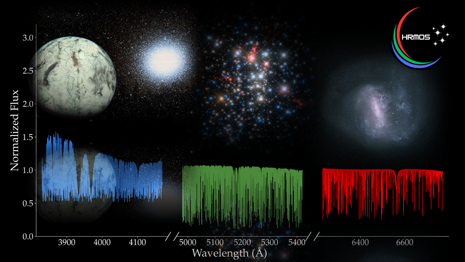
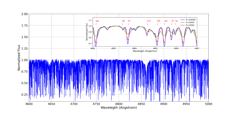
HRMOS will provide a resolving power R=80,000 in three spectral windows 385-420, 480-525, 613-675 nm, for a total coverage of 142 nm.
HRMOS will have multiplex capabilities in the range between 50 (requirement) and 80 (goal)
HRMOS will allow precise radial velocity measurements (10 m/s requirement and 5 m/s goal)
More about HRMOS



HRMOS will be driven by some transformative science cases while also allowing a broad range of cases to be covered
HRMOS will be proposed as a new instrument for the ESO VLT at the upcoming call
HRMOS documents and papers
Credits for the webpage: Maria Rosa Panzera, Laura Magrini & Jose Schiappacasse Ulloa