
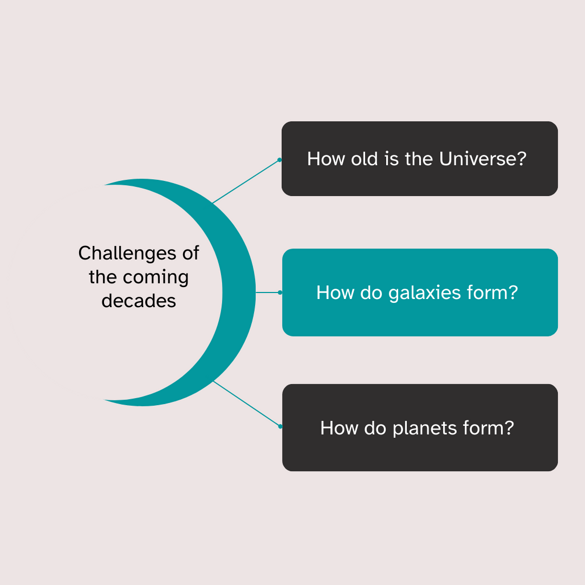
Which critical questions will shape future research?
HRMOS will provide a key contribution to addressing some of the most crucial open questions in modern astrophysics. The combination of very high-resolution spectroscopy, multiplex capabilities, and high efficiency in the blue spectral range, will deliver crucial information that would be otherwise inaccessible.
Key-questions
How old is the Universe?
The measurement of the local expansion rate of the Universe, the Hubble constant, has recently triggered an important scientific debate. JWST observations of early, massive galaxies challenge the ΛCDM model and its 13.8 billion-year age estimate. Independent age estimates of the oldest stellar objects can constrain the age of the Universe and the Hubble constant, offering new insights into this tension and presenting future prospects for improving the method’s precision (Cimatti & Moresco 2023). Using the ages of the oldest globular clusters, it is possible to independently constrain the Hubble constant supporting the use of GCs as tools for cosmological inference (Tomasetti et al. 2025). Nucleocosmochronology is expected to achieve very high precision in determining the ages of the oldest stellar populations, particularly globular clusters, improving the precision of the age of the Universe and the Hubble constant.
How do galaxies form?
According to the standard ΛCDM cosmological model, galaxies form through hierarchical assembly over cosmic time. However, recent JWST observations have uncovered unexpectedly massive galaxies within just a few hundred million years after the Big Bang, posing a significant challenge to existing models of early galaxy formation (Xiao et al. 2024). Nearby galaxies serve as invaluable laboratories for investigating remnants of early galactic building blocks. By analyzing their chemical abundances and dynamical properties—a method already highly effective in the Milky Way—this approach can be extended to neighboring galaxies of diverse morphological types. A comparative analysis across a wide range of stellar masses, star formation histories, and metallicities is essential to deepen our understanding of galaxy formation and evolutionary processes in different environments.
How do planets form?
In just over three decades since the discovery of the first exoplanet, more than 5,000 planets have been identified, revolutionizing our understanding of planetary systems and reshaping our view of planet formation and the uniqueness of the Solar System. However, the search for exoplanets has not been systematic; it has primarily focused on maximizing the likelihood of discovery rather than exploring a broad range of environments. One of the next critical steps is to conduct a systematic search in environments with varying properties—such as age, stellar density, and metallicity—including different types of star clusters, the Galactic bulge, and nearby galaxies.
Science with HRMOS
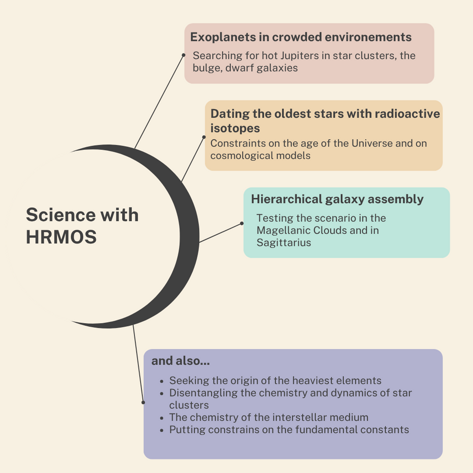
- the systematic search for hot jupiters in a wide variety of environments, from Galactic disk star clusters, to halo globular clusters, to the Bulge and nearby dwarf galaxies;
- the measurement of stellar ages using radioactive isotope decays, so that older populations can be dated accurately , preciselyand independently of stellar models;
- the study of the hierarchical galaxy formation in dwarf galaxies, tackling the problem in the Magellanic Clouds and in Sagittarius dwarf galaxy
The design of HRMOS is driven by three science cases, that could help revoluzionize our understanding of cosmology, galaxy formation, and planet formation and evolution. These which will be complemented by other drivers, proposed by the astronomical community:The scenarios are obviously not limited to these, as HRMOS will be able to address numerous scientific topics, ranging from thestudy of clusters , theorigin of the heaviest elementsup to the chemistry ofinterstellar medium. HRMOS will be a unique partner for the new generation of space missions, such asHAYDNandPLATO. It will also complement the upcoming medium-resolution spectroscopic surveys from the ground.